
Renting vs Custom E-Commerce Store: What Is Better for Business
A strategic comparison: Total Cost of Ownership (TCO) over 12, 24, and 36 months, code and database ownership, platform constraints, SEO control, and digital asset preservation.
Every entrepreneur entering e-commerce faces a fundamental choice: is it more profitable to rent an online store (SaaS platform) or invest in building a custom, independent store on an open-source CMS (OpenCart)?
Too often, discussions simplify this into «renting is cheap and fast, while custom development is expensive and slow». Real business practice shows that the initial setup fee is only the tip of the iceberg. Over 1 to 3 years, recurring subscriptions, transaction fees, feature limits, custom development costs, and legal ownership of digital assets become the true deciding factors.
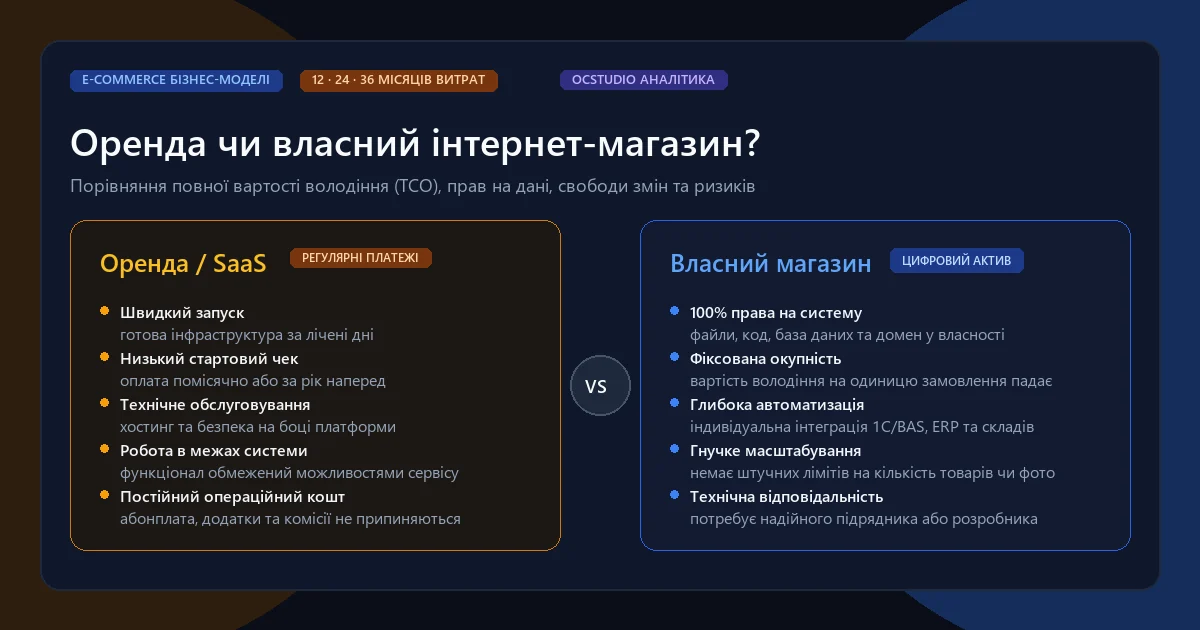
Core Difference Between Renting (SaaS) and a Custom Store
Understanding the architectural distinction is essential for sound decision-making:
- Renting an Online Store (SaaS): you subscribe to software hosted on a provider's cloud (e.g. Shopify, BigCommerce, Horoshop). Hosting, server security, and code maintenance are handled by the vendor. You pay monthly or annual recurring fees. Benefit: rapid deployment with minimal initial overhead. Limitation: no direct access to core code, risk of unexpected pricing changes, and inability to take your software with you if you leave. Explore our online store rental service for quick market testing.
- Custom E-Commerce Store (Open-source CMS / OpenCart): an independent digital platform deployed on your own hosting or dedicated VPS. You retain 100% legal and technical ownership of source code (PHP, JS, CSS) and database (MySQL). All custom features, ERP/CRM integrations, and speed optimizations are carried out without vendor restrictions. Learn more about our turnkey e-commerce development.
Calculate Costs Across 12, 24, and 36 Months: Total Cost of Ownership (TCO)
Comparing only first-month pricing is misleading. Seasoned business owners calculate TCO (Total Cost of Ownership) over 12, 24, and 36 months.
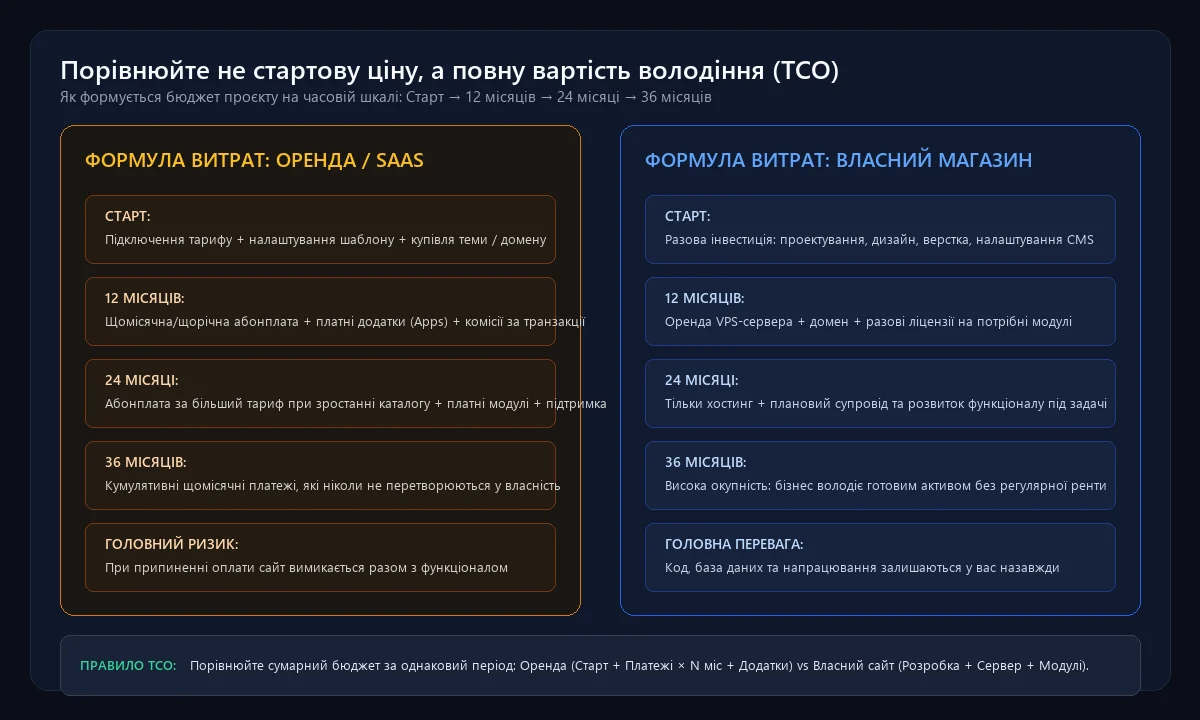
TCO Formula for Renting (SaaS)
- Initial setup: plan activation fees or agency template customization;
- Base recurring fees: monthly subscription tier ($20–$150/mo. scaling by SKU and order limits);
- Tier upgrades: compulsory plan upgrades as order volume expands;
- Paid app subscriptions: monthly fees for advanced marketing, shipping, or SEO apps ($10–$50/mo. each);
- Transaction fees: additional percentage cuts on GMV or external payment gateways;
- Hourly customization: agency rates for proprietary template adjustments.
TCO Formula for a Custom Store (OpenCart)
- Turnkey development: architecture, responsive UI, module configuration, and launch (one-time fee, check our OpenCart development pricing);
- Module licenses: one-time purchases for high-performance filters, one-page checkout, and SEO suites;
- Hosting / Server: dedicated NVMe hosting or VPS ($5–$25/mo.) dedicated entirely to your store;
- Proactive support: scheduled maintenance and backups on demand (website administration);
- Targeted feature expansion: paid only when your business genuinely requires new capabilities (OpenCart custom modifications).
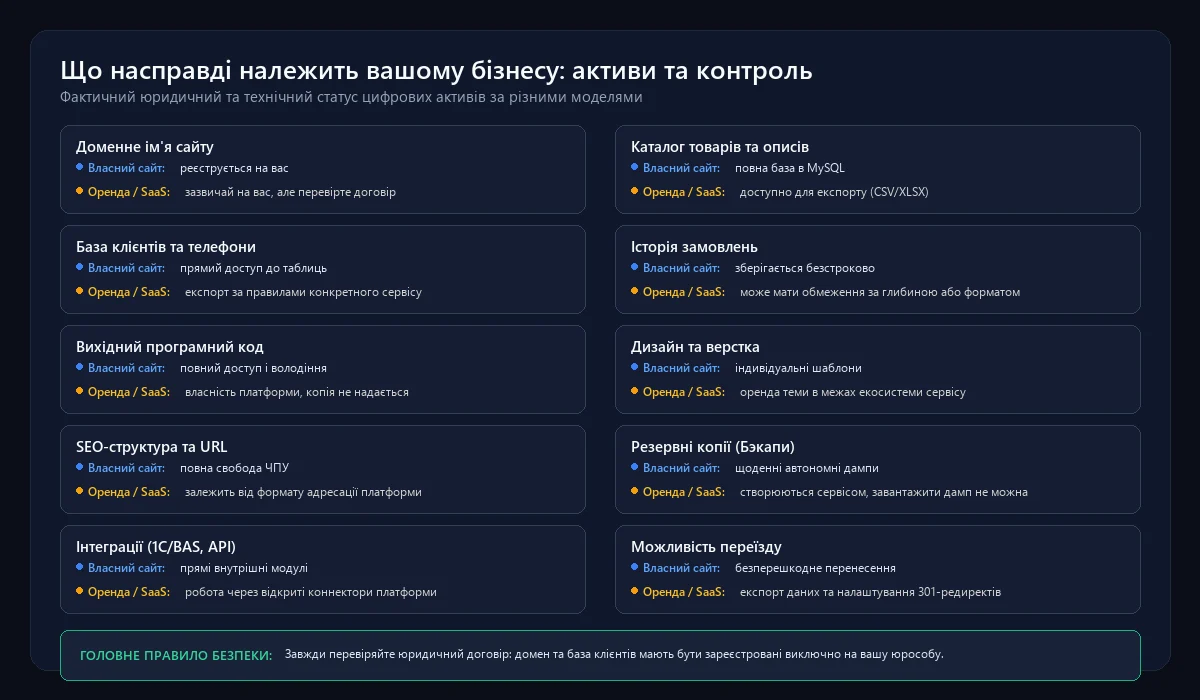
What Does Your Business Actually Own: Rights, Code, and Database
When operations scale, digital asset ownership becomes a fundamental balance sheet consideration.
10 Critical Questions Before Signing a Rental Agreement
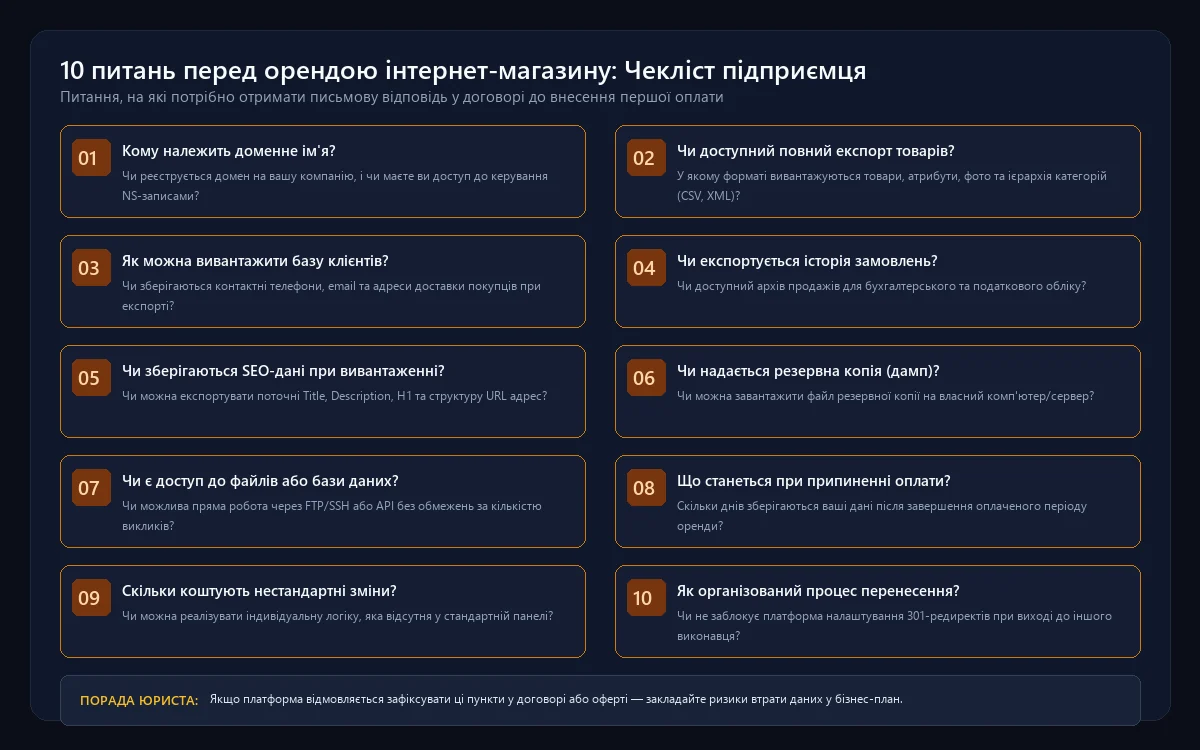
Domain Ownership
Do you retain 100% control over the registrar account and DNS records independently.
Full Catalog Export
Can you export all product variants, attributes, hi-res image URLs, and SEO data.
Customer Data Export
Is customer purchase history, delivery addresses, and contact info fully accessible.
Historical Orders
Can historical order records and order statuses be exported cleanly.
SEO URL Preservation
Can current URL paths be preserved or redirected via individual 301 redirects.
Independent Backups
Are you permitted to download offline backups of your store database and assets.
File and Markup Access
Can you edit HTML/CSS templates freely for branding and conversion optimization.
Grace Period Terms
How long is data preserved after subscription cancellation before permanent deletion.
Migration Protocol
Does vendor support assist in providing raw database exports when leaving.
Custom Feature Pricing
Can bespoke business logic be implemented and what is the vendor's hourly development rate.
Future Modifications: Integrations and Scalability
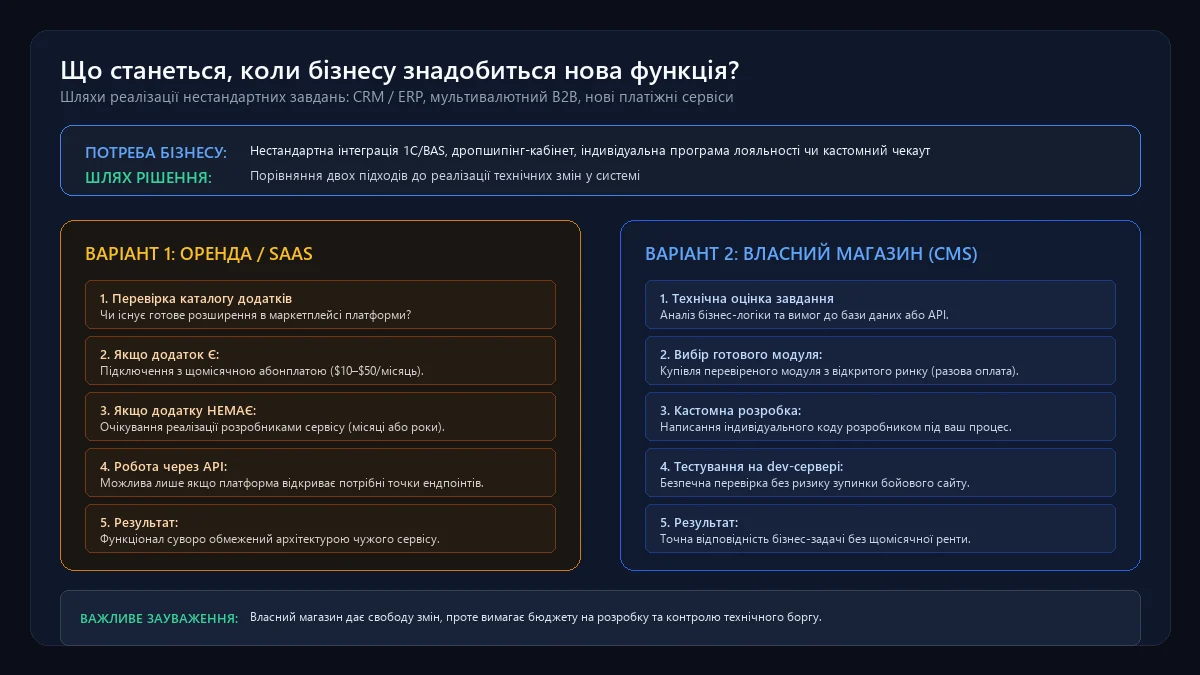
SaaS stores rely on vendor app marketplaces. If a connector does not exist, custom development is often blocked or costly. On OpenCart, any custom API or ERP workflow can be engineered seamlessly. Explore our work in process automation and custom integrations.
Renting vs Custom Store: Side-by-Side Comparison
| Evaluation Criteria | Rental (SaaS) | Custom Store (OpenCart) |
|---|---|---|
| Initial Capital Outlay (CAPEX) | Low. Initial plan payment + template activation. | Higher initial investment for turnkey engineering and design. |
| Ongoing Operational Costs (OPEX) | Continuous monthly fees that escalate with sales and SKU volume. | Predictable server hosting ($5–$25/mo.) and annual domain renewal. |
| Server & Infrastructure | Shared cloud. No access to server stack, PHP, or Nginx configurations. | Dedicated VPS/server. Full control over caching, Redis, and resources. |
| Source Code Access | Proprietary. Backend code and platform core are locked. | 100% open source. Full access to PHP, JS, CSS, and Twig files. |
| Database Access | Restricted to web dashboard exports (CSV/XLSX). | Direct MySQL/MariaDB access via phpMyAdmin, CLI, or direct queries. |
| Backups | Managed by vendor. Local full-system archives cannot be downloaded. | Automated scheduled backups to external storage (Google Drive, AWS S3). |
| Design Flexibility | Constrained by pre-built theme settings and widget limits. | Unrestricted UI/UX freedom, custom interactions, and branding. |
| ERP & Custom Integrations | Limited to supported marketplace connectors and restricted APIs. | Bi-directional sync with 1C/BAS, custom ERPs, and external APIs. |
| SEO & URL Control | Basic SEO settings. Often enforces fixed URL slugs and prefixes. | Advanced technical SEO: custom robots.txt, sitemaps, SEO filters. |
| Catalog Scalability | Subscription costs escalate across product tiers (10k, 50k, 100k SKU). | No artificial SKU tier limits; scalable purely based on server hardware. |
| Vendor Dependency | High vendor lock-in with a single proprietary provider. | Zero vendor lock-in. Supported by a worldwide open-source ecosystem. |
| 24–36 Month TCO | Cumulative subscriptions often surpass initial custom build costs. | High asset capitalization; minimal running costs post-break-even. |
When Renting is the Rational Choice
Best Fit for SaaS Rental
- MVP & Hypothesis Testing: validating market demand within 3–7 days with minimal capital;
- Standard Catalog: up to 500–1,000 SKUs without complex B2B pricing or tier rules;
- Standard Logistics: out-of-the-box payment gateways and courier shipping are sufficient;
- No Technical Staff: no internal developer or IT admin to oversee server infrastructure;
- Short-Term Horizon: pop-up stores, seasonal promotions, or under 1-year commitments.
When to Invest in a Custom Store
- Long-Term Enterprise Brand: establishing an owned, capitalized corporate asset for 2–5+ years;
- Warehouse & ERP Synchronization: automated inventory and pricing sync with 1C, BAS, or custom ERPs;
- Large Catalog: tens of thousands of SKUs requiring multi-faceted layered navigation;
- B2B E-Commerce: wholesale tiers, credit terms, custom invoicing, and client portal logic;
- Organic Search Priority: comprehensive SEO campaigns targeting vast non-branded keyword clusters.
SEO and Platform Scalability
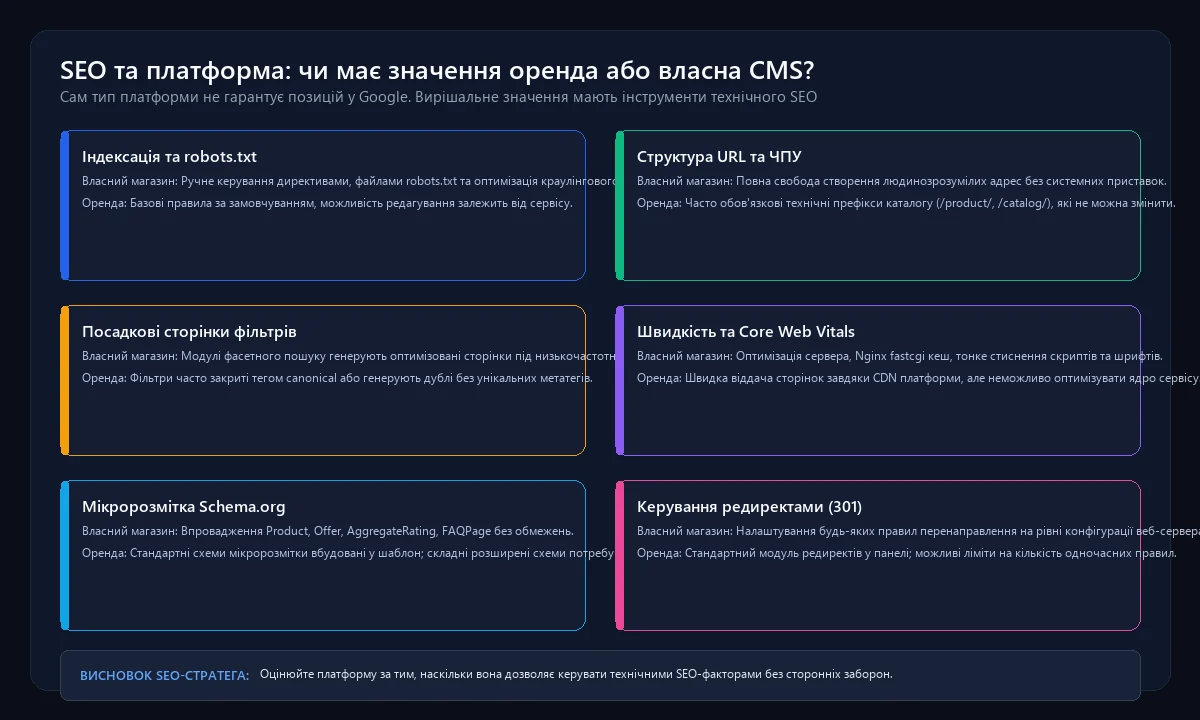
Exiting a Platform Without Business Loss (Safe Migration)
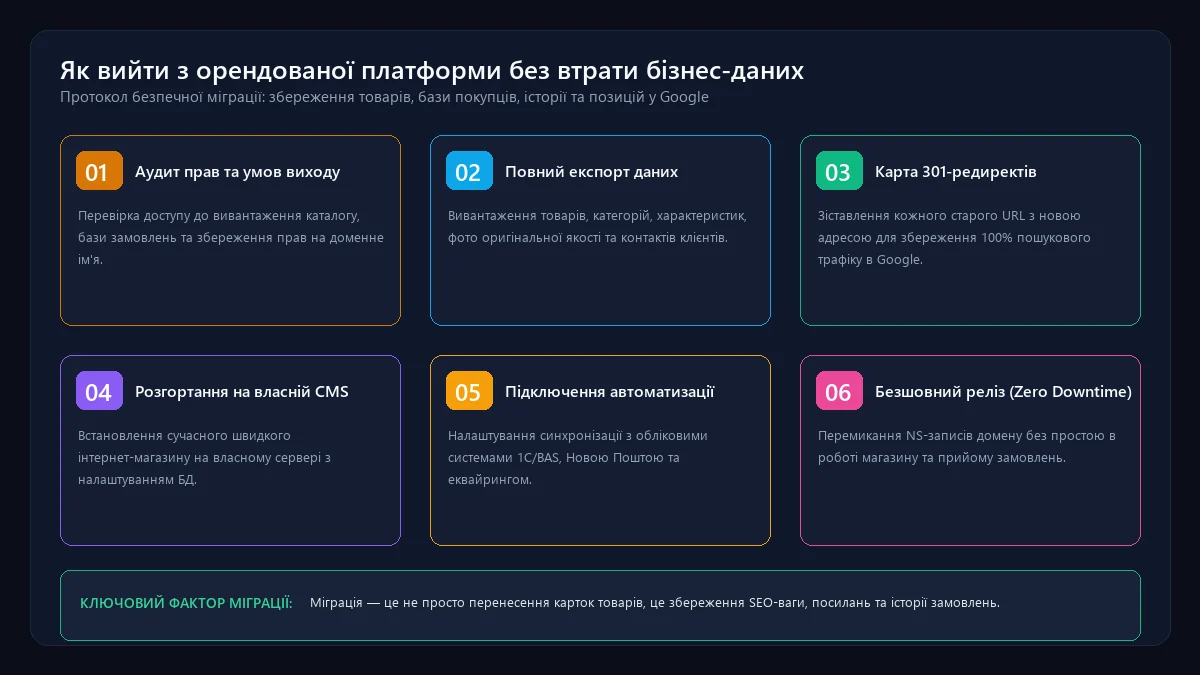
A rigorous migration process involves catalog exports, exhaustive 301 redirect mapping for every indexed URL, metadata porting, and staging environment verification before DNS cutover. See our specialized OpenCart migration services.
Frequently Asked Questions (FAQ)
Can you buy out an online store after several years of rental?
In almost all cases, no. SaaS platforms run on proprietary multi-tenant architecture. You can export catalog data and customer spreadsheets, but the underlying engine cannot be transferred. The store must be rebuilt on an independent open-source platform like OpenCart.
What happens to Google search rankings when migrating from rental to custom store?
With precise 301 redirect mapping, metadata preservation, and structured data carryover, search engine rankings remain stable or experience only brief recrawl periods (2–4 weeks). Fast NVMe servers and optimized Core Web Vitals often accelerate organic traffic growth post-migration.
How long does launching a custom online store take compared to renting?
Rented SaaS solutions launch in 2–5 days. Tailored OpenCart development with unique styling, payment/shipping modules, and ERP synchronization typically takes 3 to 6 weeks.
Why does the actual cost of renting an online store increase over time?
As catalogs and sales grow, mandatory plan upgrades, recurring app subscriptions, premium integrations, and transaction fees compound rapidly over multi-year operational horizons.
Is managing an independent OpenCart store difficult for business owners?
Day-to-day catalog management, order processing, and pricing require no coding background. Technical server management, security patching, and automated backups are easily managed through routine technical support agreements.
Compare Renting vs Custom Development for Your Project
Unsure which model fits your business? Share your catalog details, planned integrations, and operational timeframe — we will deliver an objective Total Cost of Ownership (TCO) breakdown across 12, 24, and 36 months.
Get a Consultation & TCO Estimate