
OpenCart vs Shopify: Control, Costs, Growth
In-depth technical and economic comparison of two leading e-commerce models: autonomous open-source CMS vs managed cloud SaaS. Real TCO calculation, transaction fees, and scaling limits.
Choosing an e-commerce platform determines the technological trajectory and cost efficiency of an online business for years to come. Shopify and OpenCart embody two fundamentally opposing philosophies: a fully hosted, proprietary SaaS ecosystem versus an independent, self-hosted open-source software stack.
In this guide, the OCStudio engineering team provides an objective technical and commercial comparison across three decisive pillars: Control & Data Ownership, Real Total Cost of Ownership (TCO), and Growth & Customization Potential.
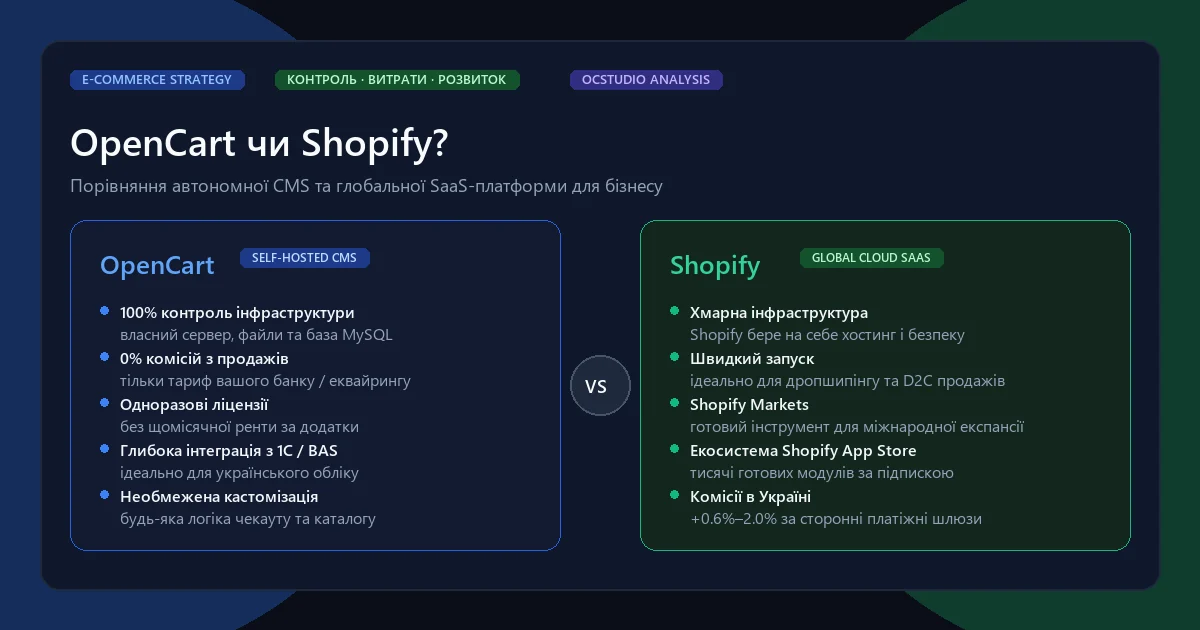
1. CONTROL: Infrastructure & Data Ownership
The primary architectural divergence between OpenCart and Shopify lies in data sovereignty. On OpenCart, you maintain 100% ownership over your database (MySQL/MariaDB), PHP source code, server configuration, and customer records. On Shopify, you rent access to a proprietary multitenant cloud engine governed by Shopify's terms of service and API quotas.
OpenCart: Sovereign Digital Asset
- Direct Database Access: Write arbitrary SQL queries, build custom indexes, connect live Business Intelligence (BI) dashboards, and execute batch imports without API throttling.
- Zero Vendor Lock-in: Deploy on any VPS, dedicated server, or private cloud. Move between hosts within minutes using standard database dumps.
- Complete Source Code Modification: Alter controller logic, customize checkout workflows, and modify template files directly without platform constraints.
Shopify: Managed Ecosystem
- API-Mediated Data Access: All catalog updates and order extraction must pass through REST or GraphQL API endpoints subject to strict rate limits (2 requests per second on standard plans).
- Proprietary Infrastructure: You cannot access server logs, configure WebServer caching (Nginx/LiteSpeed), or alter server-side PHP/Ruby runtimes.
- Compliance & Policy Risk: Shopify reserves the unilateral right to suspend accounts or restrict stores violating regional rules or payment guidelines.
Catalog Architecture: Categories vs Collections
For mid-sized and large retail catalogs, platform catalog taxonomy is vital. OpenCart uses a classic relational category tree with parent-child hierarchies, enabling multi-level category navigation, breadcrumb inheritance, and granular SEO URLs.
In contrast, Shopify utilizes a flat "Collections" architecture with automated tagging. While convenient for boutique apparel collections (e.g., "Summer Sale"), flat collections become cumbersome for complex multi-brand technical catalogs with 10,000+ SKUs across nested categories.
The 100-Variant Architectural Ceiling on Shopify
Shopify natively enforces a hard constraint: maximum 3 option types and 100 total variants per product. If your store sells items with multiple parameters (e.g., Size, Color, Material, Density), you quickly hit this barrier. Overcoming it on Shopify requires third-party subscription apps that generate duplicate hidden products, polluting your database and search index. On OpenCart, product options and attribute combinations are architecturally unlimited.
Master Comparison Table: OpenCart vs Shopify
| Feature / Parameter | OpenCart | Shopify |
|---|---|---|
| Platform Architecture | Open-source, self-hosted (PHP / MySQL) | Proprietary cloud SaaS (Liquid / Ruby) |
| Code & Database Ownership | 100% full ownership of files and database | Rented access; API-restricted database |
| Monthly Base Platform Cost | $0 (Zero platform subscription fee) | $39 / $105 / $399 per month |
| Third-Party Gateway Commission | 0% (Direct contract with payment acquirer) | +0.5% to +2.0% surcharge per order |
| Product Variant Limits | Unlimited options & attributes | 3 options / 100 variants max |
| Custom Checkout Flow | Full source code customization (Simple Checkout) | Locked (Customizable only on Shopify Plus $2,000+/mo) |
| ERP & Warehouse Integration | Direct bidirectional sync (BAS, 1C, CRM, WMS) | API-only sync with rate quotas |
| URL Structure & SEO Pro | Arbitrary semantic ЧПУ URLs, clean hierarchy | Rigid /products/ and /collections/ prefixes |
| Hosting Control | Freedom to select any server/country | Shopify proprietary cloud exclusively |
2. COSTS: Real Total Cost of Ownership (TCO)
At first glance, Shopify appears cost-effective with low barrier to entry. However, as an e-commerce business grows in revenue and catalog size, the cumulative SaaS operational expenses (OPEX) surge significantly.
Third-Party Payment Gateway Surcharges
Shopify operates its own payment gateway, Shopify Payments. If Shopify Payments is unavailable in your jurisdiction (such as Ukraine and many non-EU/US markets), or if you use local bank acquirers (Monobank, LiqPay, WayForPay, Stripe), Shopify imposes an additional transaction penalty on every sale:
- Basic Plan ($39/mo): +2.0% platform surcharge per transaction.
- Shopify Plan ($105/mo): +1.0% platform surcharge per transaction.
- Advanced Plan ($399/mo): +0.5% platform surcharge per transaction.
For an online store generating $30,000 in monthly turnover on the Basic plan, this penalty alone amounts to $600 every month ($7,200 annually) paid directly to Shopify in addition to normal bank processing fees. On OpenCart, platform transaction fees are 0%.
App Store Expenses: One-Time vs Recurring Subscriptions
A standard e-commerce store requires advanced functionality: loyalty points, custom filters, abandoned cart triggers, multi-currency display, and delivery branch selection. On Shopify, these features are supplied via monthly App Store subscriptions averaging $15-$50/month per app. A typical growing Shopify store incurs $150 to $350 monthly just for essential plugins.
On OpenCart, extensions (such as OCFilter, Simple Checkout, Seo Pro, Neoseo) are purchased as one-time lifetime licenses ($25-$80 per module) with zero recurring monthly subscription costs.
3-Year TCO Comparison (Turnover $25,000 / month)
Shopify (Shopify Plan + 5 Apps + 1% surcharge):
- Platform Base Fee: $105 × 36 = $3,780
- Essential App Subscriptions: $200 × 36 = $7,200
- 1% Transaction Surcharge: $250 × 36 = $9,000
- Initial Setup & Theme Adaptation: $2,500
- Total 3-Year Outlay: ~$22,480
OpenCart (Custom Development + VPS Hosting + Lifetime Modules):
- Platform Subscription: $0
- Turnkey Store Development & Design: $3,500 - $6,000 (one-time)
- Lifetime Extension Licenses: $450 (one-time)
- High-Performance VPS Hosting: $25 × 36 = $900
- Annual Maintenance & Optimization: $1,200 × 3 = $3,600
- Total 3-Year Outlay: ~$8,450 - $10,950
Net Business Savings: over $11,500 in 36 months, with complete code ownership remaining an enterprise company asset.
3. GROWTH: Scaling, Custom Logic & Multi-Store Markets
As retail operations mature, enterprise requirements inevitably emerge: custom B2B discount tiers, automated warehouse sync, multi-warehouse stock allocations, and custom single-page checkouts.
On Shopify, altering checkout behavior or adding custom delivery selectors (like Nova Poshta branch pickers) is restricted unless you upgrade to Shopify Plus, which starts at $2,000/month. On OpenCart, checkout is fully open and can be customized to any workflow required by your sales and fulfillment departments.
SEO: Does Organic Search Performance Depend on Platform Architecture?
Both platforms can achieve high Google rankings when properly optimized, but OpenCart provides technical SEO professionals with far superior structural control:
- Clean Semantic URLs: Shopify mandates strict URL patterns:
/products/item-nameand/collections/cat-name/products/item-name. OpenCart allows 100% custom ЧПУ URLs matching your exact category hierarchy without duplicate URL sprawl. - Automated 301 Redirect Mapping: OpenCart handles legacy URL migrations with custom regex rules and database-driven redirect maps directly in Apache or Nginx, ensuring swift indexing transitions.
- Server-Level Caching & Core Web Vitals: OpenCart allows fine-tuned Redis, Memcached, OpCache, and WebP image generation on your own VPS, achieving lightning-fast Time to First Byte (TTFB).
Who Should Choose Shopify vs Who Needs OpenCart
Choose Shopify If:
- You are launching a single-product brand, dropshipping store, or test MVP.
- Your catalog is small (under 200 products) with few option variations.
- You operate in countries where Shopify Payments is natively supported.
- You do not have access to technical development resources.
Choose OpenCart If:
- You have a multi-category catalog (500 to 200,000+ SKUs) with complex filters.
- You require deep, real-time integration with BAS, 1C, custom CRM, or WMS systems.
- You operate in Ukraine or Europe and want zero platform transaction surcharges.
- You view your e-commerce store as a core long-term capital asset, not an operational rental.
Store Migration: Moving from Shopify to OpenCart
If your store has reached the operational or financial ceiling of Shopify, migrating to OpenCart is a proven path to higher margins and complete autonomy. OCStudio performs comprehensive turnkey migrations from Shopify to OpenCart with a structured engineering protocol:
- Catalog Extraction: Complete export of products, variants, high-resolution imagery, and meta descriptions via Shopify REST API.
- Customer & Order History Import: Preserving historical customer profiles, delivery addresses, and past order records.
- SEO URL Mapping: Building a comprehensive 1-to-1 301 redirect map from legacy Shopify paths to clean OpenCart URLs, preventing search equity loss.
- ERP & Gateway Integration: Connecting local payment providers (0% surcharge) and real-time inventory synchronization with BAS/CRM.
Frequently Asked Questions (FAQ)
What transaction fees does Shopify charge for third-party gateways?
If you do not use Shopify Payments (unavailable in many markets, including Ukraine), Shopify imposes an additional transaction fee of 0.5% to 2.0% on top of your bank acquirer fees. On OpenCart, there are zero platform fees: you pay strictly the direct fee of your merchant bank.
What product variant limits apply to Shopify vs OpenCart?
Shopify natively restricts products to a maximum of 3 option types and 100 total variants per product without complex workarounds or paid apps. OpenCart has no architectural variant limits: products can support unlimited options and attribute combinations.
Can the checkout page be customized on both platforms?
On standard Shopify plans, checkout is hosted and locked down: you cannot add custom fields or local delivery branch pickers without a Shopify Plus enterprise subscription ($2,000+/month). OpenCart provides full checkout source code access, enabling single-page checkouts (Simple Checkout) and custom validation logic.
Which platform offers superior e-commerce SEO capabilities?
Shopify enforces rigid URL structures (forcing /products/ and /collections/ prefixes) and complicates multi-category canonical mapping. OpenCart allows arbitrary clean semantic URL structures, granular canonical control, and full microdata optimization without duplicate URL indexing.
How does Total Cost of Ownership (TCO) compare over 3 years?
While Shopify offers lower initial setup costs, recurring monthly subscriptions for core plans, essential App Store add-ons ($150-$350/mo), and third-party transaction fees result in a 3-year TCO that frequently exceeds $12,000-$25,000. OpenCart requires an upfront development investment but negligible recurring overhead ($10-$30/mo for VPS hosting), with one-off module purchases delivering dramatic 3-year savings.
Conclusion
Shopify is an exceptional tool for rapid prototyping, cross-border dropshipping, and micro-brands with simple catalogs. However, for established retail enterprises, manufacturers, and multi-category merchants, OpenCart offers unassailable advantages: zero platform commissions, unrestricted customization, unlimited variant architecture, and total control over your digital business assets.